
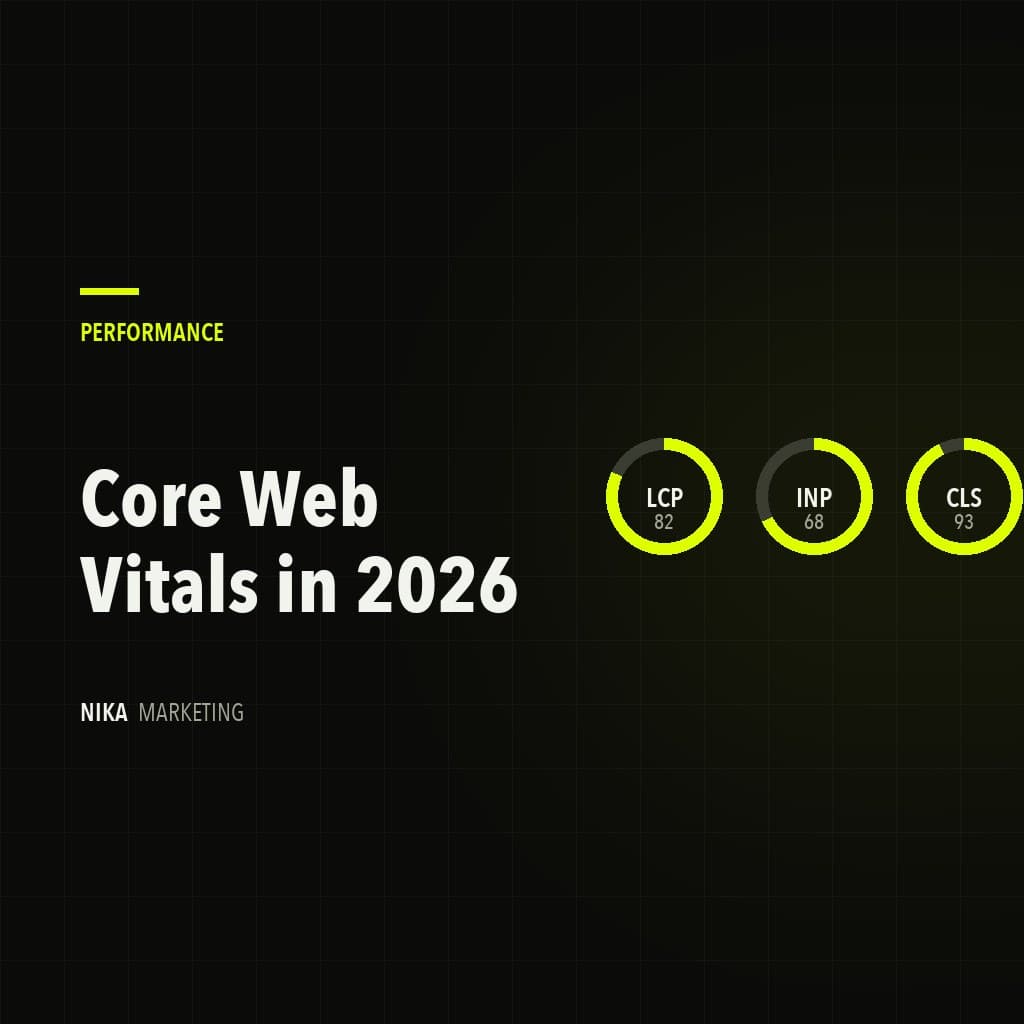
Google's Core Web Vitals evolved into a single Holistic Score in 2026, combining Largest Contentful Paint (LCP), Interaction to Next Paint (INP), Cumulative Layout Shift (CLS), and a new set of engagement and stability signals into one weighted number that directly influences how your pages rank. Passing each metric individually is no longer enough. Google now evaluates the overall experience of a page as a single verdict, and sites that scrape by on two out of three old metrics can still fail the new combined score. For marketing websites competing for local and commercial search terms, this shift makes page experience a ranking factor you can no longer treat as a background technical task.
From Three Separate Metrics to One Holistic Score
For years, Core Web Vitals worked like a report card with three independent grades: LCP, INP (which replaced First Input Delay in 2024), and CLS. A page could pass two of the three and still show up in Search Console as “needs improvement” rather than an outright failure, and many sites treated a 2-out-of-3 pass rate as good enough. The 2026 Holistic Score changes that math entirely. Google now computes a blended experience index per page template, weighting the three legacy metrics alongside real-world engagement data: bounce-after-load rate, scroll depth on first paint, and repeat-visit stability. A page can no longer coast on a strong LCP while quietly shipping a janky, shifting layout; the algorithm treats everything from first load to first interaction as one continuous experience, not three checkboxes.
Breaking Down the Metrics That Still Matter
Largest Contentful Paint measures how long it takes for the biggest visible element, usually a hero image, headline, or banner, to render on screen. Google's threshold for “good” is still 2.5 seconds or faster, and LCP remains the single heaviest-weighted input in the Holistic Score because it's the clearest proxy for perceived load speed. If your homepage hero image or above-the-fold video takes more than 2.5 seconds to paint, everything else you fix afterward is fighting an uphill battle.
Interaction to Next Paint measures the latency between a user's click, tap, or keypress and the moment the browser visually responds, sampled across the entire page visit rather than just the first interaction. Google wants INP under 200 milliseconds. This metric punishes bloated JavaScript the hardest: heavy third-party scripts, tracking pixels, and chat widgets that hijack the main thread are the most common causes of a failing INP score, especially on mobile devices with less processing power.
Cumulative Layout Shift measures visual stability, meaning how much content unexpectedly jumps around as a page loads, like a paragraph shoving down when an ad or image finally renders. Google's target is a CLS score under 0.1. Unsized images, web fonts that swap in late, and injected banners or cookie notices without reserved space are the usual culprits. CLS is often the cheapest of the three to fix, yet it's the one most marketing sites still ignore.
What's New in the 2026 Holistic Score
Beyond the three legacy metrics, the 2026 scoring model adds two new inputs. The first is Interaction Consistency, which tracks whether responsiveness holds steady throughout a session instead of degrading as more scripts load and memory fills up, a common problem on content-heavy blogs and image-driven service pages. The second is Visual Readiness, which measures how quickly text becomes both visible and stable enough to read without shifting, closing a gap between LCP (which only checks the largest element) and CLS (which only checks movement). Google has been explicit that these additions are meant to catch pages that “game” the old three metrics individually while still delivering a frustrating real-world experience.
How to Audit Your Site with PageSpeed Insights and Chrome DevTools
Start with PageSpeed Insights, which now surfaces your Holistic Score directly alongside the individual metric breakdown and flags whether your data comes from real-user field data (CrUX) or lab simulation. Field data is what actually affects rankings, so prioritize any page with enough traffic to generate a CrUX report. From there, open Chrome DevTools' Performance panel and record a trace of your homepage and top landing pages: look at the flame chart for long JavaScript tasks over 50 milliseconds (these are what tank INP), check the Layout Shift entries in the Experience section for CLS culprits, and use the Lighthouse tab to get a prioritized, page-specific fix list. Running this audit monthly on your five highest-traffic pages will catch regressions before Google's next crawl does.
The Fixes That Actually Matter
Image optimization delivers the fastest LCP wins: serve modern formats like WebP or AVIF, compress hero images without visible quality loss, and set explicit width and height attributes so the browser reserves space before the image loads. Lazy loading everything below the fold (images, embedded videos, and iframes) keeps the initial page weight lean so the browser can focus on rendering what's actually visible first. Reducing JavaScript bundle size matters most for INP: audit every third-party script (chat widgets, marketing pixels, A/B testing tools) and defer or remove anything that isn't essential to the first interaction, since a single bloated analytics bundle can single-handedly push INP over Google's threshold. Server-side rendering, or at minimum pre-rendering critical above-the-fold content, gives users a meaningful first paint before client-side JavaScript takes over, which helps both LCP and the new Visual Readiness signal.
How Failing the Holistic Score Affects Your Rankings
Google has confirmed that page experience remains a tie-breaking and, in some verticals, a direct ranking signal, and the Holistic Score raises the stakes because it's harder to partially pass. Industry data from 2026 shows that pages moving from a failing to a passing Holistic Score saw organic click-through rate increase by an average of 14 to 22 percent within eight weeks, driven largely by lower bounce rates feeding back into Google's engagement signals. Conversely, sites that fail the Holistic Score on mobile, where Google still evaluates the majority of ranking signals, are seeing measurably slower re-crawl frequency, which delays how quickly new content and updates get indexed in the first place. In competitive local and service-based search results, a failing score can be the difference between page one and page two even when your content and backlink profile are otherwise comparable to a competitor's.
Your Action Plan: What to Fix First
Don't try to fix everything at once. Start with LCP on your highest-traffic landing pages, since it carries the most weight in the Holistic Score and typically has the highest-impact, lowest-effort fixes available (image compression, hero image preloading, removing render-blocking CSS). Next, tackle CLS across your whole site template. Fixing image dimensions and font-loading behavior once in your theme or component library fixes every page at the same time. Finally, work through INP page by page, starting with any page that has a contact form, calculator, or interactive element, since those are exactly the pages where a slow response costs you a lead, not just a ranking point.
Why This Matters Even More for Marketing Websites
Marketing and agency websites are disproportionately exposed to Holistic Score failures because they tend to run the exact stack that causes problems: heavy hero images and video backgrounds for brand impact, a dozen or more third-party marketing and analytics scripts, embedded forms and chat widgets on every page, and frequent content updates that introduce new layout shift risk. Unlike an e-commerce catalog page that can be templated once and left alone, a marketing site's landing pages are constantly being rebuilt for new campaigns, which means Core Web Vitals regressions creep in with every launch unless performance is part of the QA checklist. If your business depends on organic search and paid landing pages to generate leads, the Holistic Score isn't a developer concern anymore. It's a revenue metric.